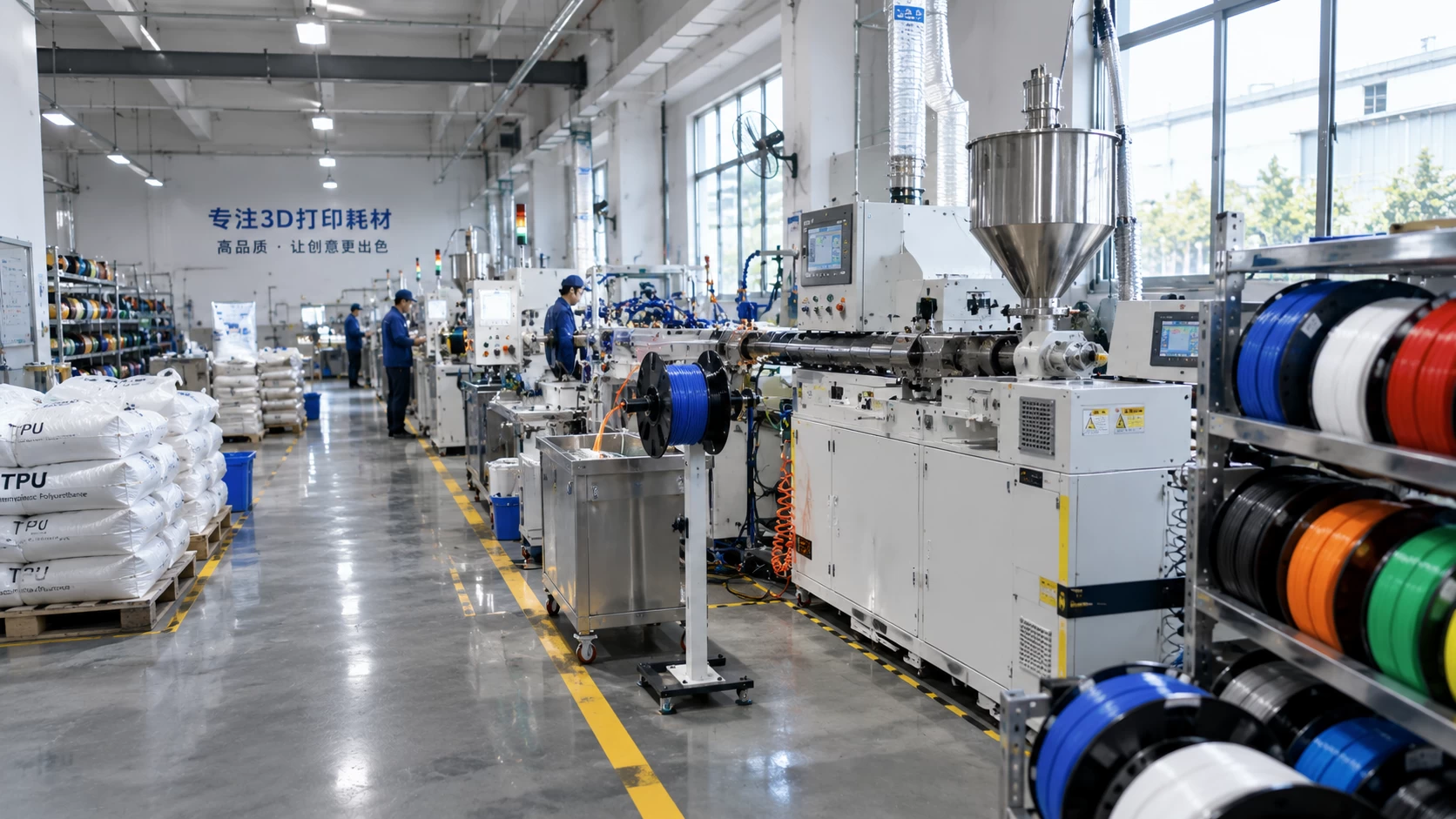
TPU 95A is the practical choice when you need a flexible part that still holds its shape. TPU 85A is softer, easier to compress and better for seals, grips and vibration damping. The right choice depends on stiffness, geometry and how well your printer handles flexible filament.
What Shore hardness actually means
Shore A hardness describes how resistant a material is to indentation. A higher number is harder. TPU 95A is firmer than TPU 85A, but both remain flexible compared with rigid filaments such as PLA, PETG or ABS.
Hardness is only one part of the story. Part geometry, wall thickness, infill, temperature and print orientation can change how a finished part feels and performs. A thin 95A wall can feel softer than a thick 85A section.
TPU 85A at a glance
TPU 85A is a softer grade. It is often used when the part needs to compress, grip, seal or absorb vibration.
Typical strengths - Soft, compliant feel - Good grip and surface contact - Useful for seals, bumpers, grips and dampers - Can conform to uneven surfaces
Trade-offs - More difficult to feed through long Bowden paths - More sensitive to retraction settings - Often requires slower printing and lower flow - Thin walls can collapse or deform more easily
TPU 85A works best with a short, well-supported filament path. A direct-drive extruder usually gives more control than a long Bowden tube. Start slowly and increase speed only after the extrusion is stable.
TPU 95A at a glance
TPU 95A is firmer and more dimensionally stable. It is a common starting point for functional flexible parts because it balances flexibility with printability.
Typical strengths - Holds shape better than 85A - Easier to print on a wider range of printers - Good for wear pads, cable strain relief, wheels and protective covers - More predictable dimensions in thin and medium sections
Trade-offs - Less compliant than 85A - Not a replacement for very soft rubber in high-compression applications - Still requires moisture control and tuned retraction
TPU 95A is usually the easier grade to validate first. If the part feels too stiff, test 85A. If the part is too soft or deforms under load, move back toward 95A or change the geometry.
TPU 95A vs TPU 85A comparison
| Property | TPU 85A | TPU 95A |
|---|---|---|
| Relative hardness | Softer | Firmer |
| Flexibility | Higher | Moderate |
| Shape retention | Lower | Higher |
| Grip / compression | Excellent | Good |
| Print difficulty | Higher | Lower |
| Typical use | Seals, grips, dampers | Pads, covers, strain relief |
| Dimensional stability | Lower | Higher |
These are general tendencies. Actual values depend on the formulation, color, additives and manufacturer's TDS.
Print settings to start with
TPU does not have one universal temperature. Start with the filament supplier's recommended range and verify it with a temperature tower and a flow test.
- Nozzle temperature: use the supplier's range; avoid overheating, which increases stringing and degradation.
- Bed temperature: follow the TDS; a mild bed temperature and a clean surface usually work better than aggressive adhesion.
- Speed: begin slowly, then increase in small steps. TPU is sensitive to back pressure.
- Flow: calibrate rather than guessing. Over-extrusion makes flexible parts feel stiffer and can cause surface defects.
- Retraction: use the shortest reliable retraction. Long retraction can cause grinding or gaps.
- Cooling: moderate cooling helps surface quality, but excessive cooling can reduce layer adhesion.
For 85A, reduce speed further and simplify the filament path. For 95A, you have more room to tune, but drying and flow calibration still matter.
When to choose TPU 85A
Choose 85A when the part must compress or conform. Examples include soft grips, seals, vibration isolators, protective corners and parts that need a rubber-like feel. If the part is thin or has long unsupported walls, expect more trial prints.
When to choose TPU 95A
Choose 95A when the part needs flexibility but must keep its shape under load. Examples include cable strain relief, wheels, wear pads, flexible hinges, protective covers and functional prototypes. It is usually the better first choice for teams that are new to flexible filament.
Common mistakes
- Using rigid-filament retraction settings
- Printing too fast before calibrating flow
- Leaving TPU exposed to moisture
- Judging hardness from a single thin sample
- Assuming all 95A or 85A formulations behave the same
FAQ
Is TPU 95A stronger than TPU 85A?
Not automatically. Hardness and strength are different properties. A 95A grade may hold shape better, while an 85A grade may absorb more deformation without cracking. Check the TDS for tensile strength, elongation and tear resistance.
Can I print TPU 85A on a Bowden printer?
It is possible, but it is more difficult. Minimize the filament path, reduce speed and tune retraction carefully. A direct-drive extruder is usually more reliable.
Do I need to dry TPU?
Yes. TPU can absorb moisture. Wet filament can cause bubbles, inconsistent extrusion, poor surface finish and weak layer bonding. Dry it according to the supplier's recommendation and store it sealed with desiccant.
Conclusion
Start with TPU 95A when you need a flexible part that keeps its shape and is easier to print. Move to TPU 85A when compression, grip or damping is the main requirement and you are prepared to tune the printer more carefully. Always verify the current TDS before production.
Related pages - Browse filament materials - View TPU 95A material page - Explore print profiles - Request a material recommendation